Always good to see mobile phones rise during your talk: it usually means your slide contains valuable, practical information. I noticed this whenever I showed my Claude Code configuration slide.
Claude Code offers many options; my setup strips away the ones I don’t need. Here I cover each setting, what it does, and why I changed it.
Simplicity
I keep Claude Code simple, optimized for its core capabilities, token efficient where possible and inspectable. My configuration revolves around these three core principels.
Inspection, UI
First, I configure my terminal to have as much scroll back space as possible. I do this in VS Code’s terminal, in MacOS Terminal and in iTerm2. Terminal output is mostly text and consumes little memory. Set it to 100k lines or so.

Next: --verbose, which makes every tool call and token exchange visible. Aren’t we all used to scrolling timelines on X or Insta? Your terminal is no different. I set BASH_MAX_OUTPUT_LENGTH to 99999 to preserve full shell output, I want to be able to see it all. I combine this with flicker reduction by setting prefersReducedMotion. This can be done in Claude’s own settings.json.
$ claude --verboseThe file ~/.claude/settings.json will now look like:
{
  "prefersReducedMotion": true,
  "env": {
    "BASH_MAX_OUTPUT_LENGTH": "99999"
  }
}
To strip the UI furthermore I turn off feedbackSurveyRate and tips via spinnerTipsEnabled and CLAUDE_CODE_ENABLE_PROMPT_SUGGESTION. I don’t need them. Also, I use the IS_DEMO=1 env variable to reduce startup info. Not needed for me. Be aware though that using IS_DEMO in a fresh directory skips the onboarding safety check. So, it’s best to use it on recurring sessions, or just accept the bloat at the top of the screen at startup.
Additionally I like to keep my terminal tab titles as I configured them. So, I set CLAUDE_CODE_DISABLE_TERMINAL_TITLE to 1 so Claude will not write conversation state to it. It’s distracting and annoying.
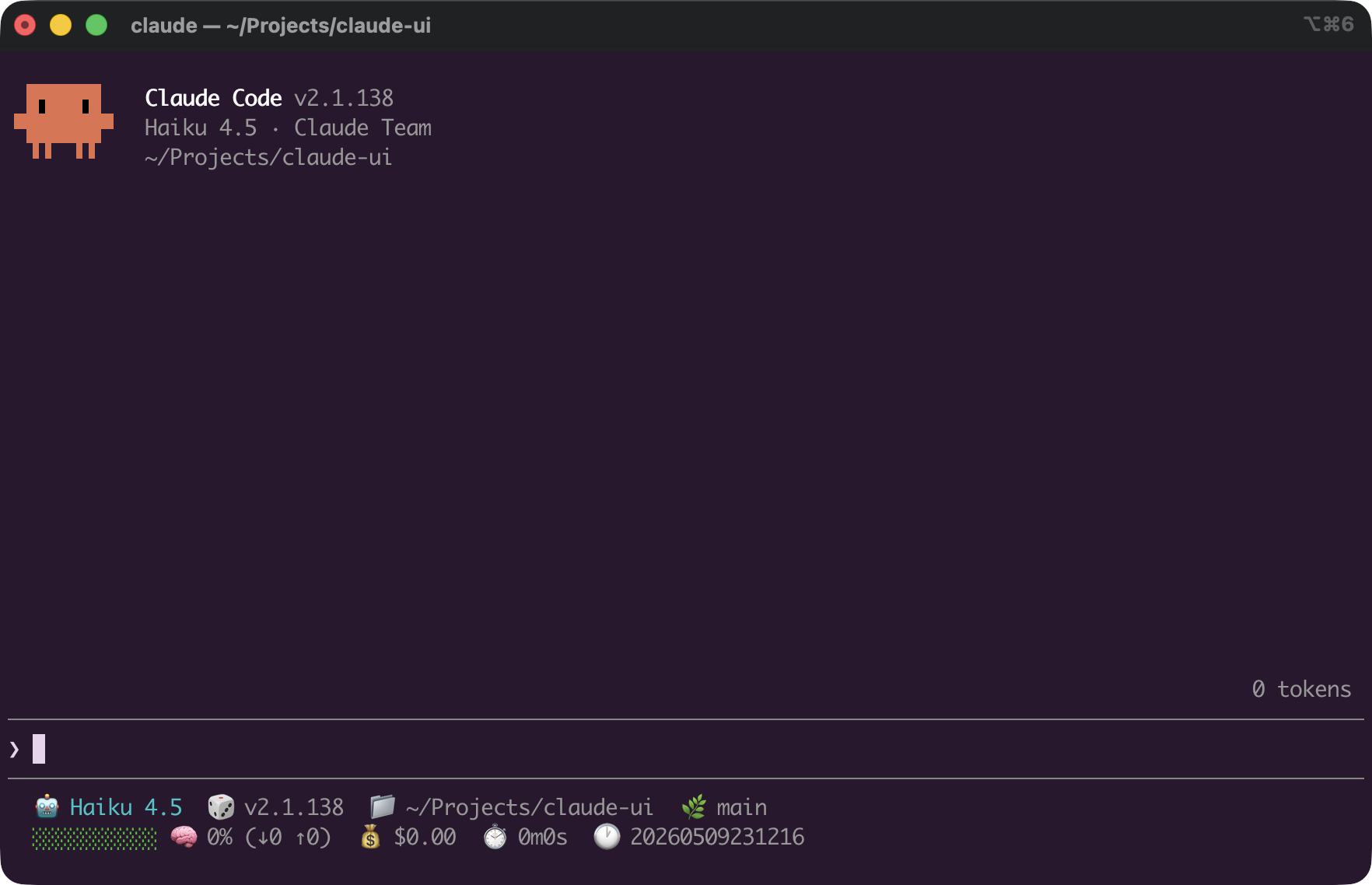
IS_DEMO=1, the TUI is now nice and clean.The file ~/.claude/settings.json will now look like:
{
  "prefersReducedMotion": true,
  "feedbackSurveyRate": 0,
  "spinnerTipsEnabled": false,
  "env": {
    "BASH_MAX_OUTPUT_LENGTH": "99999",
    "CLAUDE_CODE_ENABLE_PROMPT_SUGGESTION": "false",
    "CLAUDE_CODE_DISABLE_TERMINAL_TITLE": "1"
  }
}
Most valuable config change: cleanupPeriodDays
My most valuable config change is to set Claude’s session file cache on disk to a very high value. Claude cleans up sessions older than 30 days from its home directory. Disk space is cheap. Have you ever installed Docker and built some images? It consumes gigabytes. Why not have a little more persistence for Claude?
I put the session cache, per property cleanupPeriodDays to 99999. I want to keep all my session logs as sometimes I pick up old projects after months to continue with them. Sure, it is good to keep your project’s state in code, but sometimes I just want to know how our conversation went.
Claude Code is a conversational AI code writing tool. The conversation is a key element. Discarding them without thought wastes learning.
The file ~/.claude/settings.json will now look like:
{
  "cleanupPeriodDays": 99999,
  "prefersReducedMotion": true,
  "feedbackSurveyRate": 0,
  "spinnerTipsEnabled": false,
  "env": {
    "BASH_MAX_OUTPUT_LENGTH": "99999",
    "CLAUDE_CODE_ENABLE_PROMPT_SUGGESTION": "false",
    "CLAUDE_CODE_DISABLE_TERMINAL_TITLE": "1"
  }
}
Default permissions
Next up is permissions. Claude can be so eager to produce code that it should be guided. Yes, I do use YOLO mode sometimes but when I don’t, I want to be clear on the guard rails. No editing of lock files, no editing of dependencies, ask for reading into dependencies but always allow git and certain bash commands.
The file ~/.claude/settings.json will now look like:
{
  "cleanupPeriodDays": 99999,
  "prefersReducedMotion": true,
  "feedbackSurveyRate": 0,
  "spinnerTipsEnabled": false,
  "env": {
    "BASH_MAX_OUTPUT_LENGTH": "99999",
    "CLAUDE_CODE_ENABLE_PROMPT_SUGGESTION": "false",
    "CLAUDE_CODE_DISABLE_TERMINAL_TITLE": "1"
  },
  "permissions": {
    "allow": [
      "Bash(git *)",
      "Bash(grep *)",
      "Bash(wc *)",
      "Bash(ls *)",
      "Bash(find *)",
      "Bash(cat *)",
      "Bash(head *)",
      "Bash(tail *)",
      "Bash(curl *)",
      "Read(~/.zshrc)"
    ],
    "deny": [
      "Write(node_modules/**)",
      "Write(package-lock.json)",
      "Write(yarn.lock)",
      "Write(pnpm-lock.yaml)",
      "Write(Cargo.lock)",
      "Write(target/**)",
      "Read(~/.zshenv)",
      "Read(.env)"
    ],
    "ask": [
      "Read(node_modules/**)"
    ]
  }
}
Token use
To reduce token use, I set "CLAUDE_CODE_DISABLE_FAST_MODE": "1", I prefer lower cost over higher speed. Also, I always disable telemetry and error reporting.
Complete settings.json
So, that’s it! The file ~/.claude/settings.json will now look like:
{
  "$schema": "https://json.schemastore.org/claude-code-settings.json",
  "cleanupPeriodDays": 99999,
  "prefersReducedMotion": true,
  "feedbackSurveyRate": 0,
  "spinnerTipsEnabled": false,
  "env": {
    "BASH_MAX_OUTPUT_LENGTH": "99999",
    "CLAUDE_CODE_ENABLE_PROMPT_SUGGESTION": "false",
    "CLAUDE_CODE_DISABLE_TERMINAL_TITLE": "1",
    "CLAUDE_CODE_DISABLE_FEEDBACK_SURVEY": "1",
    "DISABLE_FEEDBACK_COMMAND": "1",
    "DISABLE_TELEMETRY": "1",
    "DISABLE_ERROR_REPORTING": "1",
    "CLAUDE_CODE_DISABLE_FAST_MODE": "1"
  },
  "permissions": {
    "allow": [
      "Bash(git *)",
      "Bash(grep *)",
      "Bash(wc *)",
      "Bash(ls *)",
      "Bash(find *)",
      "Bash(cat *)",
      "Bash(head *)",
      "Bash(tail *)",
      "Bash(curl *)",
      "Read(~/.zshrc)"
    ],
    "deny": [
      "Write(node_modules/**)",
      "Write(package-lock.json)",
      "Write(yarn.lock)",
      "Write(pnpm-lock.yaml)",
      "Write(Cargo.lock)",
      "Write(target/**)",
      "Read(~/.zshenv)",
      "Read(.env)"
    ],
    "ask": [
      "Read(node_modules/**)"
    ]
  },
  "statusLine": {
    "type": "command",
    "command": "/Users/vincentb/Projects/statusline/statusline.sh",
    "padding": 0
  },
  "effortLevel": "high",
  "tui": "fullscreen",
  "voiceEnabled": false
}
Anthropic changes Claude Code configuration frequently. It might be that in a few months this article contains information that is no longer applicable. Verify your configuration with either the Claude Code documentation website or validate it against the JSON schema.